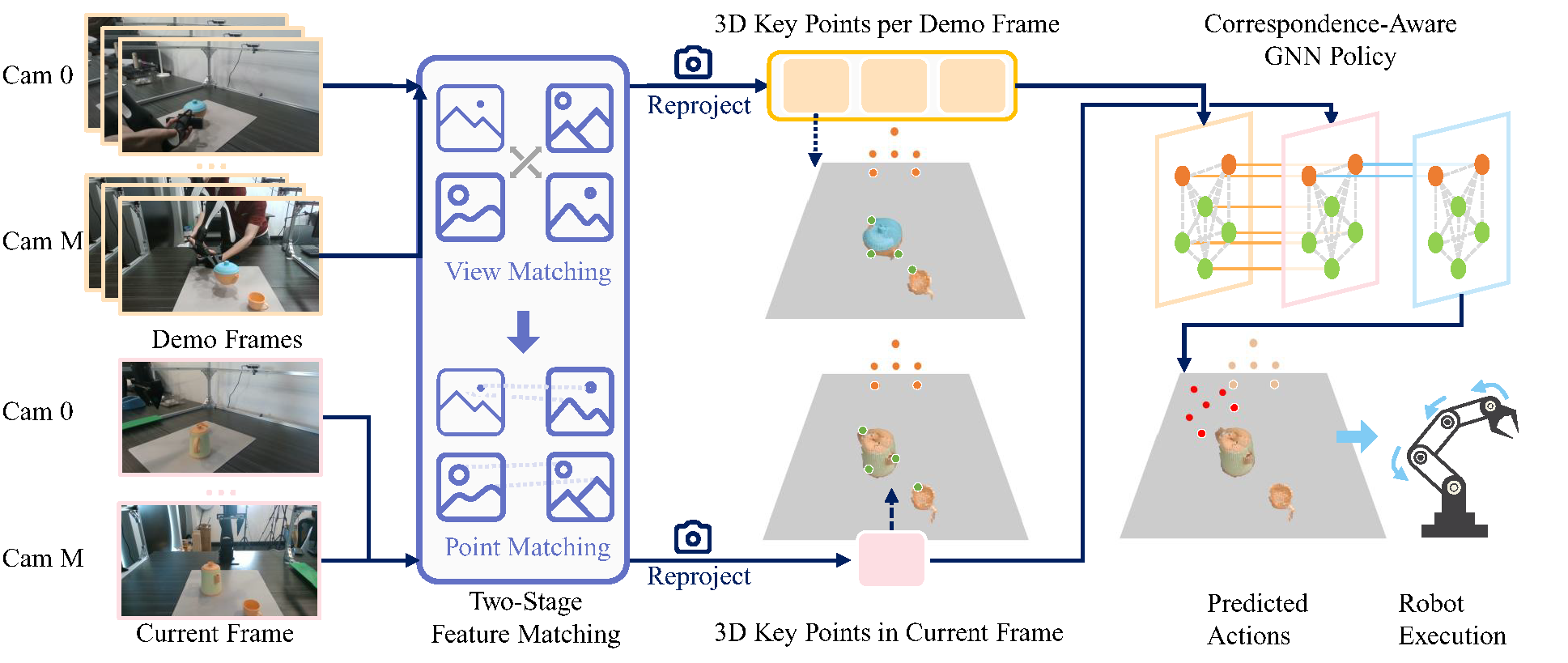
In-context imitation learning allows policies to generalize from few-shot demonstrations, yet it often struggles with unseen objects or novel scenarios. To address this, we introduce MatchingPolicy, a correspondence-driven framework that decouples demonstration-to-scene matching from policy learning. At its core, MatchingPolicy uses a graph-based diffusion policy that adapts robot actions via dense semantic correspondences. This explicit separation eliminates the challenge of simultaneous correspondence inference and action adaptation, enabling robust transfer. Our approach integrates a vision foundation model with a novel two-stage matching algorithm to dynamically establish reliable correspondences. Empirical evaluations on RLBench and real-world manipulation tasks show that MatchingPolicy achieves strong few-shot performance, generalizing consistently across unseen object instances and categories.